
What sets Tower Rush apart in the crowded crash-game category is its architectural metaphor. Instead of watching a multiplier curve or a rocket trajectory, you watch a tower grow floor by floor, each level a discrete decision point rather than a continuous graph. The 98.5% RTP sits comfortably above many slots, and the betting range from £0.01 to £100 accommodates cautious climbers and high-stakes architects alike. This review examines how the mechanics work, what strategies hold up under scrutiny, and whether Tower Rush deserves a place in your regular rotation at reputable online casinos.
Tower Rush: key facts
| Provider | Galaxsys |
|---|---|
| Type | Crash / Building game |
| RTP | 98.5% |
| Volatility | High |
| Min / max bet | £0.01 / £100 |
| Max win | £10,000 |
| Mobile | Yes |
| Demo | Yes |
Tower Rush delivers white-knuckle crash gameplay with exceptional RTP and clear risk-reward mechanics, though the high volatility demands strict bankroll discipline.
What is Tower Rush?
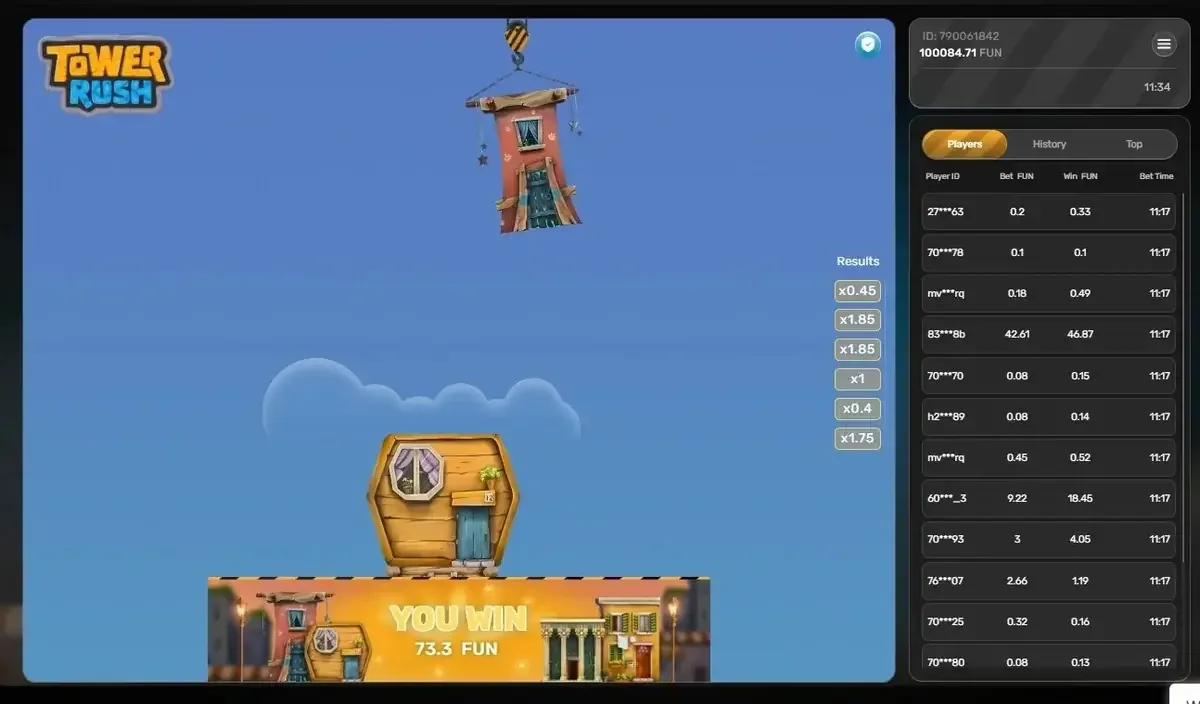
Tower Rush belongs to the crash-game family, a category defined by multipliers that grow until a random collapse point wipes accumulated winnings. Where many crash games visualise this as a rising curve or flying object, Tower Rush frames it as architectural construction: you place a bet, then watch your funds climb a 36-storey structure, with each floor reached adding to your multiplier. The tower can collapse at any moment, and if you have not cashed out before that happens, you lose the entire stake.
Galaxsys built the game on provably fair technology, meaning the collapse point for each round is determined by a cryptographic hash before you place your bet. The system reveals this outcome progressively as you climb, floor by floor, creating the illusion of real-time decision-making whilst the result was mathematically fixed from the start. This does not mean the game is rigged—provably fair algorithms are transparent and auditable—but it does mean your climbing choices do not influence where the tower will fail, only whether you exit before it does.
The game sits within the 'Crash & mines games' section at most partner casinos, alongside titles like Aviator, JetX, and Mines. Its appeal lies in the control it offers: you are never waiting for a random number generator to deliver a symbol combination. Instead, every round is a test of timing and nerve, with profits entirely dependent on when you choose to walk away. The 98.5% RTP is unusually generous for this category, though as with all gambling products, the house edge ensures long-term losses for the majority of players.
How to play Tower Rush?
1: Set your stake and launch the climb
Select a bet amount between £0.01 and £100 using the stake controls beneath the tower. Once your stake is set, press the 'Play' button to begin your ascent. The tower immediately starts building, with the first floor appearing and your multiplier activating. Unlike slots where you wait for the reels to stop, Tower Rush demands attention from the first second—the collapse can theoretically occur at any floor, including the very first.
2: Climb and watch your multiplier grow
As the tower rises, each successfully placed floor increases your multiplier according to a fixed schedule. The game displays your current level, the active multiplier, and your potential winnings in real time. The early floors offer modest returns, but the multiplier accelerates sharply in the upper levels. You can continue climbing as long as the tower holds, with the maximum 36th floor delivering the peak payout. The visual feedback is clear: a glowing indicator shows your position, and the potential cash amount updates with every floor.
3: Cash out before the tower collapses
At any point after the first floor, you can press the 'Cash Out' button to bank your accumulated winnings. The moment you cash out, your profit transfers to your balance and the round ends. If you wait and the tower collapses before you exit, you lose the entire stake. The game does not warn you when collapse is imminent—there is no countdown or visual cue beyond the inherent knowledge that higher floors carry greater risk. Optional auto-cashout settings let you predefine an exit multiplier, removing emotional decision-making from the equation.
How much can you win?
The maximum win in Tower Rush is £10,000, achieved by reaching the 36th floor on a £100 stake. This ceiling represents the absolute limit programmed into the game, regardless of how high your multiplier climbs. For smaller bets, the cap still applies: a £10 wager reaching the top floor would yield £1,000, and so on proportionally. The game uses a fixed multiplier structure across all 36 floors, with exponential growth in the upper tiers where the collapse risk intensifies.
The 98.5% RTP means that, over millions of rounds, the game returns £98.50 for every £100 wagered. This is an average calculated across all players and all outcomes, from first-floor collapses to perfect 36-floor climbs. Individual sessions will deviate wildly from this figure—some players will lose ten consecutive stakes, others will hit a lucrative high-floor cashout—but the mathematical edge always favours the house. The high volatility amplifies these swings: long losing streaks are common, punctuated by occasional large wins that keep the RTP in the advertised range.
- Maximum payout per round: £10,000 (requires maximum £100 stake and reaching the top floor).
- RTP of 98.5% applies universally, irrespective of stake size or climbing strategy.
- Higher floors deliver exponentially larger multipliers but with correspondingly higher collapse probability.
- Bonus floors (Frozen Floor, Temple Floor, Triple Build) can appear randomly, modifying win calculations or offering temporary protection.
- Auto-cashout presets allow systematic profit-taking at chosen multiplier thresholds, removing guesswork from exit timing.

Strategies and good habits
Set a target multiplier and stick to it
Chasing the 36th floor on every climb is a recipe for rapid bankroll depletion. Instead, identify a realistic multiplier target—perhaps x2.00 or x3.00—and use the auto-cashout function to exit automatically when you reach it. This removes the temptation to push for just one more floor after a successful run. Track your results over 50 or 100 rounds to see whether your chosen target produces net gains or losses, then adjust accordingly. The goal is consistency, not the occasional windfall that costs you ten stakes to achieve.
Manage your stake relative to your bankroll
High volatility means long losing streaks are inevitable. A sensible approach is to never wager more than 1–2% of your total bankroll on a single climb. If you start with £100, that means stakes of £1 to £2 per round. This gives you enough runway to absorb the statistical variance without going broke during an unlucky sequence. Increasing your stake after losses—so-called martingale strategies—accelerates the bleeding when variance goes against you, and Tower Rush offers no mechanism to recover previous losses beyond starting a new round.
Use the demo to test approaches without financial risk
Partner casinos typically offer Tower Rush in demo mode, allowing you to climb with play-money credits. This is invaluable for understanding how multipliers scale, how often the tower collapses at different floors, and whether your chosen cashout strategy holds up over extended sessions. The demo uses the same RNG and mechanics as real-money play, so the behaviour you observe is directly applicable. Spend an hour in demo mode before committing real funds, and treat it as cheap education rather than a preview of guaranteed profits.
Free demo or real money?
The demo version of Tower Rush is functionally identical to the real-money variant: same RTP, same volatility, same collapse mechanics. The only difference is the absence of financial risk. This makes the demo the ideal environment for testing cashout strategies, exploring the bonus floors, and developing a feel for the game's rhythm. You will not win actual money, but you also will not lose any, which makes it the smart starting point for new players or anyone considering a shift in their climbing approach.
Switching to real-money play introduces psychological pressure that the demo cannot replicate. Watching your own funds at stake changes decision-making: you will be tempted to cash out earlier out of fear, or to push higher out of greed. Both impulses undermine disciplined strategy. If you move to real stakes, start with the absolute minimum bet (£0.01) until you have completed at least 50 rounds and confirmed that your demo strategy translates to real conditions. The house edge does not care whether you are playing for pennies or pounds—it grinds away at the same 1.5% regardless—but smaller stakes extend your playtime and reduce the emotional turbulence that leads to poor decisions.
A word on responsible gambling: Tower Rush, like all casino games, is designed to take more money than it returns over time. The 98.5% RTP is attractive, but it still means a 1.5% mathematical disadvantage that compounds with every round. Set a loss limit before you start, and stop when you reach it. Never chase losses, never wager money you cannot afford to lose, and remember that the demo exists precisely so you can enjoy the game without financial consequence. If you find yourself unable to stop or feeling distressed about losses, seek help from organisations such as GamCare or BeGambleAware. Tower Rush is entertainment, not an income stream.
Our opinion
Tower Rush succeeds because it distils crash-game mechanics to their purest form. There are no complex side bets, no convoluted bonus rounds, no obfuscation of the core risk-reward exchange. You bet, you climb, you cash out or you lose. The 98.5% RTP is amongst the best in the mini-game category, and the fixed multiplier structure removes any ambiguity about what each floor is worth. The visual design is clean and functional, prioritising information over spectacle, which suits the genre perfectly. The inclusion of bonus floors (Frozen Floor, Temple Floor, Triple Build) adds occasional variety without cluttering the core experience.
The game's Achilles' heel is its high volatility. Long losing streaks are not anomalies—they are the expected outcome of a game where most climbs end in collapse. This demands rigorous bankroll management and emotional discipline that many casual players lack. If you approach Tower Rush hoping for steady, incremental gains, you will be disappointed. The game rewards patience and mathematical literacy, punishing impulsive stake increases and revenge chasing. The auto-cashout feature mitigates some of this by enforcing pre-set exit points, but it cannot protect you from the fundamental reality that the house edge will erode your funds over time. Tower Rush is excellent at what it does, but what it does is take your money at a slightly slower rate than most competitors.
👍 Pros
- Exceptional 98.5% RTP, amongst the highest in crash-style games.
- Clear, intuitive mechanics with no hidden complexity or ambiguous payouts.
- Auto-cashout and auto-bet features support disciplined, systematic play.
- Wide betting range (£0.01 to £100) accommodates all bankroll sizes.
- Demo mode available for risk-free strategy testing.
👎 Cons
- High volatility produces long losing streaks that can quickly drain bankrolls.
- Bonus floors appear randomly with no player control, reducing strategic depth.
- The game offers no mechanism to recover losses beyond starting a new round.
- Reaching the 36th floor is statistically rare, making the maximum payout more theoretical than practical.
Frequently asked questions
Can I influence where the tower collapses?
No. The collapse point is determined by a provably fair algorithm before you place your bet. Your climbing choices affect only whether you cash out before that predetermined point, not where the collapse occurs.
What is the best cashout multiplier for consistent profits?
There is no universally best multiplier. Lower targets (x1.50 to x2.00) hit more frequently but yield smaller returns; higher targets (x5.00+) pay more but fail more often. The 98.5% RTP ensures long-term losses regardless of strategy—your choice determines variance, not profitability.
Do bonus floors appear on every climb?
No. Frozen Floor, Temple Floor, and Triple Build trigger randomly. The game does not publish their exact probability, so you cannot predict or force their appearance. Treat them as occasional variance reducers rather than reliable strategy components.
Is Tower Rush available on mobile devices?
Yes. The game runs in mobile browsers without requiring a download, and the interface adapts to touchscreens. Performance is smooth on modern smartphones and tablets, with no meaningful difference from desktop play.
How does Tower Rush compare to other crash games like Aviator?
Tower Rush uses discrete floors rather than a continuous multiplier curve, which some players find easier to read. The 98.5% RTP is higher than many competitors. However, both games share the same core mechanic: a rising multiplier with a random collapse point. Your preference will hinge on visual presentation rather than fundamental gameplay differences.